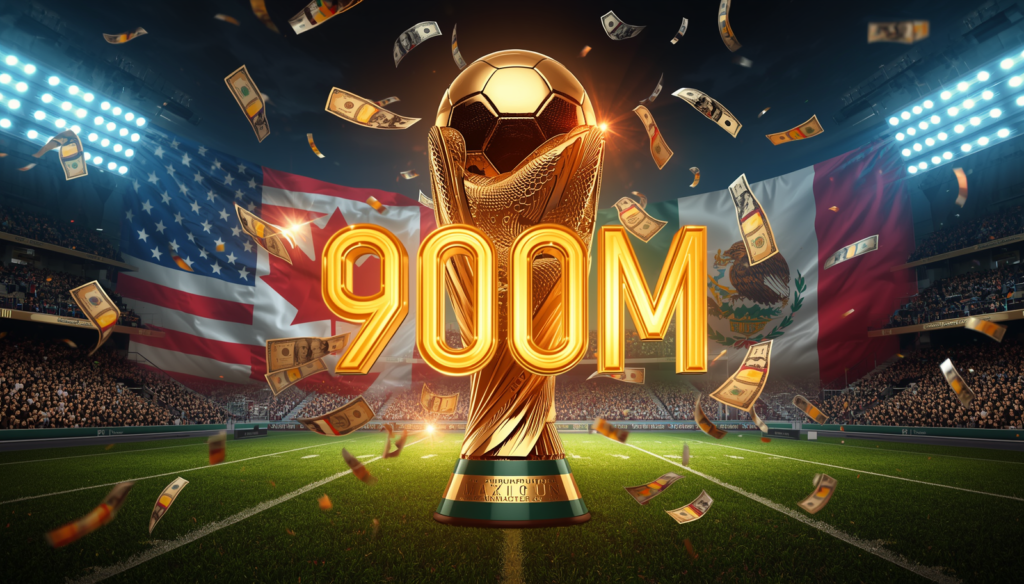
The Road to 2026 just got a whole lot richer. As of late April 2026, FIFA has officially confirmed a staggering increase in the FIFA World Cup 2026 prize money, boosting the total financial distribution to nearly $900 million. This 50% increase from the 2022 tournament in Qatar is a direct response to the spiraling logistics costs of a 48-team tournament spread across three massive nations. For the first time, even the teams that exit in the group stages will see a payout that could transform their domestic football infrastructure.
This financial windfall is more than just a headline; it is a lifeline for the smaller nations making their debut in 2026. With the tournament expanding to 104 matches over 39 days, the logistical burden on football federations is immense. By injecting these funds, FIFA aims to ensure that the “48-team experiment” is a success both on and off the pitch. Let’s break down where that money is going and the unique rules FIFA is introducing to keep the game competitive.
The Breakdown: Who Gets the $50 Million?
The most exciting part of the FIFA World Cup 2026 prize money announcement is the top-tier payout. The winning nation in the July 19th final at MetLife Stadium will walk away with a record-breaking $50 million. The runners-up aren’t far behind with $33 million, while the third and fourth-placed teams will secure $29 million and $27 million respectively. These figures represent the highest financial rewards in the history of international sports.
Beyond the podium, the distribution for the “New Round of 32” has also seen a significant hike. For many mid-tier nations, reaching the knockout stages now guarantees a payout that exceeds what the winners used to receive just two decades ago. This influx of cash is designed to encourage federations to invest in youth development and long-term scouting. For the latest updates on which teams are leading the race for these prizes, visit our Tournament Predictions Section.
Unique Twist: The New “Homegrown Player” Rule
In a move that caught many by surprise this week, the FIFA Council has approved a consultation process for a revolutionary regulatory obligation. Starting in the 2026-2027 cycle, senior club teams may be obliged to have at least one homegrown player (U-20 or U-21) on the field at all times. This is FIFA’s way of ensuring that the massive revenue from the 2026 World Cup trickles down to the grassroots level and creates a sustainable path for young talent.
This “Homegrown Rule” is intended to prevent clubs from simply buying their way to success with international stars. For countries like the USA and Canada, where youth development is rapidly accelerating, this could be the catalyst for a new “Golden Generation.” For fans of fifahub26.com, this means the 2026 World Cup will be the final tournament before the global club landscape changes forever. It adds a layer of “future-proofing” to the sport that we haven’t seen in previous eras.
Shock Absences: The Giants Who Fell
Despite the expansion to 48 teams, the April 2026 qualification wrap-up has revealed some heartbreaking results. The FIFA World Cup 2026 prize money will unfortunately not be reaching some of the sport’s biggest names. In a shocking turn of events, Italy (Ranked 12th) has once again failed to qualify, marking a dark decade for the four-time champions. Joining them on the sidelines are African powerhouse Cameroon and European stalwarts like Denmark and Hungary.
The absence of Cameroon is particularly symbolic of the unpredictability in African qualification. Despite their heroic performance in 2022, internal conflicts between the federation and coaching staff have derailed their 2026 dreams. This means fans won’t get to see world-class players like Andre Onana on the big stage. For a deep dive into how these giants fell, check out our Scouting & Analysis Category.
Technology and the Data Era: 2026 Trends
As we approach kick-off, another unique trend for 2026 is the integration of stadium data. FIFA is partnering with universities to track fan journeys from the gate to their seats, using AI to manage the massive crowds expected in North America. This isn’t just about security; it’s about the fan experience. The 2026 World Cup is set to be the most “connected” sporting event in human history, with stadiums in cities like Dallas and Los Angeles acting as giant digital hubs.
Furthermore, “Sponsorship Performance Marketing” is replacing traditional boards. Brands are now looking for measurable clicks and fan engagement rather than just logo visibility. For the players, this means taking greater control of their commercial identity. We are seeing superstars build independent platforms to engage directly with fans, bypassing traditional media. This shift is redefining what it means to be a “World Cup Hero” in the digital age.
Conclusion: A Tournament of Firsts
The 2026 FIFA World Cup is more than just a football tournament; it is a financial and technological revolution. From the $900 million prize pool to the controversial new homegrown rules, FIFA is aggressively reshaping the game. While we will miss the presence of giants like Italy and Cameroon, the rise of debutants like Uzbekistan and Jordan ensures that the “World” in World Cup remains truly global.
Stay tuned to fifahub26.com as we track the final warm-up matches and injury reports leading into June. The stakes have never been higher, and the rewards have never been greater. For the official schedule of the 104 matches, visit the FIFA World Cup 26 Official Site. The countdown to history has officially begun!